THE ENVIRONMENT
Talking about Cabo de Gata is much more than talking about a simple place. This territory is full of life in the broadest sense of the word. From its natural wealth and biodiversity to its historical and cultural richness. A protected natural area that is unique in the world due to its singularity and the importance of its still wild nature.
Cabo de Gata
But what exactly is it? Where is Cabo de Gata? Many people ask this question. The truth is that there are many “Cabo de Gata” concepts. Talking about Cabo de Gata means much more than a single place. Here’s a brief introduction to clarify what we mean by ‘the cape.’
- The Cabo de Gata: The geodetic point and geographic feature that gives the area its name, the tip of the cape itself. It is the southeasternmost point of the Iberian Peninsula. A volcanic promontory, home to the foundations of an ancient castle and the famous lighthouse.
- San Miguel de Cabo de Gata: A coastal village and district belonging to Almería city, commonly referred to simply as “Cabo de Gata.” Known for its salt flats and maritime tradition.
- Sierra de Cabo de Gata: A volcanic mountain range of submarine origin, formed 14 million years ago in the Mediterranean. It stretches from the district of La Fabriquilla, where the cliffs leading to the lighthouse begin, to the town of Carboneras.
- Cabo de Gata – Níjar Natural Park: A protected natural area established in 1987. It was the first natural park in Almería province and one of Spain’s pioneering maritime-terrestrial natural parks. It includes the volcanic mountain range and Mediterranean steppe areas, stretching from the Cabo de Gata salt flats to the village and district of Retamar.
Protected Natural Area
Talking about Cabo de Gata as a protected natural area is like talking about Michael Phelps as an athlete and the sheer number of Olympic medals he has won. By a stroke of fate, this natural area escaped the rampant urban and coastal development that affected much of Spain between the 1960s and 1980s, preserving a wild and untouched landscape.
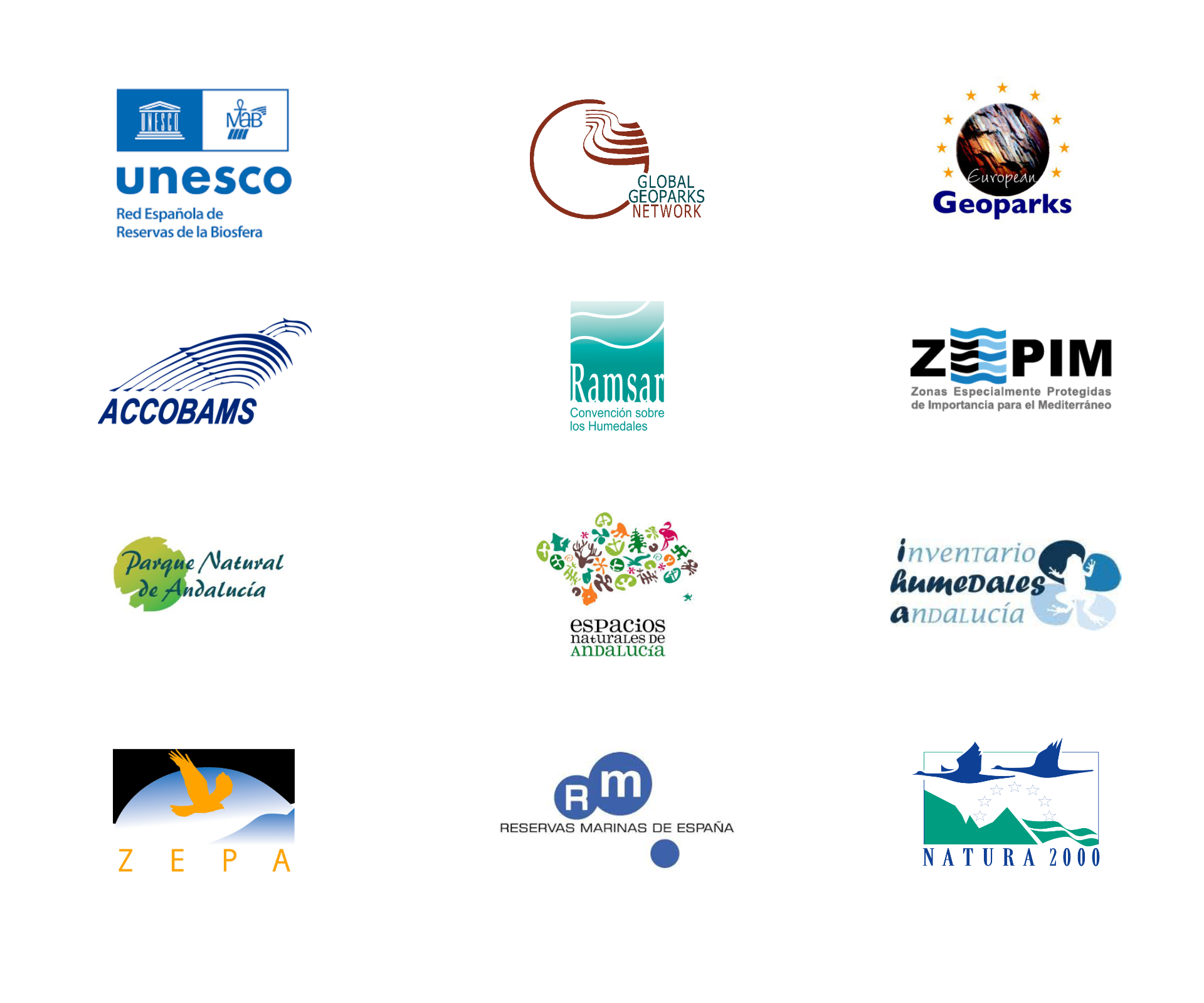
Today, this protected area benefits from numerous and significant national, European, and global protection statuses. These highlight the importance and uniqueness of its landscapes, habitats, and ecosystems, as well as the remarkable biodiversity of its flora and fauna and its unique geological features.
The first protection designation came in 1987, when it was declared a Natural Park. Additionally, it has the special classification of “maritime-terrestrial” due to the singularity of its marine ecosystems and biodiversity along its 63 km of coastline, protected up to 2 nautical miles from the shore. According to the original expansions, the park comprises 37,500 hectares of protected land and 12,012 hectares of protected sea, totaling 49,512 hectares, making it the largest volcanic natural park in Spain, larger than other volcanic parks such as Corona Forestal or the Chinijo Archipelago.
Protection Frameworks
Below are some of the key conservation designations that apply to Cabo de Gata, ranging from regional and national statuses to European and globally recognized protections.
International
- Specially Protected Area of Mediterranean Importance (SPAMI)
- Ramsar Site (Wetland of International Importance)
- UNESCO Global Geoparks Network
- UNESCO Biosphere Reserve
- Critical Habitat for Cetaceans (CCH)
National and Regional
- Maritime–Terrestrial Natural Park (RENPA)
- State Marine Reserve
- Cultural Heritage Site
- Andalusian Wetlands Inventory
European (Natura 2000 Network)
- Special Protection Area for Birds (SPA)
- Special Areas of Conservation (SAC)
Geology
Talking about the geology of Cabo de Gata means stepping into one of the most unique volcanic landscapes in the Mediterranean. Here, the land tells a story written in lava, ash, and ancient submarine eruptions that shaped this territory millions of years ago. Visitors don’t just observe mountains and cliffs, they witness the legacy of an ancient volcanic arc that emerged from the seabed and today forms the largest volcanic area on the Iberian Peninsula.
The volcanic formations, visible in cliffs, domes, and solidified lava flows, showcase a surprising variety of igneous rocks such as andesites, dacites, and basalts. Patient and constant erosion has sculpted these hardened masses into sharp profiles, rocky spires, tucked-away coves, and natural platforms that reveal the park’s complex geology. Every fold, fracture, and vertical wall exposes the mineral memory of the Mediterranean.
The result is a unique geological landscape, where the arid character of the environment blends with reliefs formed in deep marine settings. Ancient volcanism, active between 14 and 8 million years ago, gave rise to structures such as the Sierra de Cabo de Gata, the domes of Los Escullos, the cliffs of La Isleta del Moro, and fossilized reefs scattered along the coast. All of this makes the park an outdoor laboratory, internationally recognized as a Geopark for its scientific, educational, and scenic value.
Biodiversity
Without a doubt, the greatest surprise of this protected natural area is its biodiversity, as varied as the landscapes it encompasses. These are wild, harsh places where survival is a daily challenge, and yet the region hosts a remarkable diversity of organisms, both marine and terrestrial, flora and fauna. Its aridity, geographic isolation, unique geography, and geological history have produced numerous endemic species found only within the park, nearby areas, or parts of North Africa.
Flora: Cabo de Gata is home to over 1,000 species of terrestrial plants, all adapted to its harsh environment. Even American plants like prickly pears and agaves have acclimated to the region, shaping landscapes reminiscent of classic Wild West films. The underwater world holds one of the Mediterranean’s greatest ecological treasures: Posidonia oceanica, an endemic seagrass critically endangered and vital as a habitat for countless other species. It forms an underwater “Amazon rainforest” and is one of the planet’s oldest plants, having coexisted with the dinosaurs. Some clones of Posidonia can live up to 100,000 years, a testament to its resilience.
Fauna: Marine life includes impressive animals such as whales, dolphins, and small sharks, along with turtles, squid, rays, moray eels, and octopuses. The most abundant, however, are small invertebrates living among the Posidonia meadows, alongside a variety of fish. Large populations of nacres were once common but are now nearly extinct in the Mediterranean.
On land, birds are the most diverse group, thanks to the park’s multiple ecosystems, especially its salt flats and lagoons. Around 140 species have been cataloged, including the pink flamingo, Eurasian eagle-owl, Bonelli’s eagle, and most notably the Dupont’s lark, one of Europe’s most threatened birds. Terrestrial mammals include foxes, wild boars, hedgehogs, hares, goats, and genets, while reptiles and amphibians, such as frogs, toads, snakes, lizards, and the charismatic common chameleon, add further diversity to the park.
Local Culture
The culture of Cabo de Gata is born from both the sea and the land. For centuries, artisanal fishing set the rhythm of life in its small coastal villages. The jábegas (traditional fishing boats), boatyards, and the tuna-trap system known locally as “la moruna” were essential techniques for catching tuna and other migratory species for generations. Introduced by the Phoenicians and perfected by the Moors, this system left a deep mark on the maritime identity of the cape, where the rituals, fishing crews, and traditional trades that shaped the coastline’s character are still remembered.
But Cabo de Gata was not solely defined by the sea: it was also a hub of industry and commerce long before becoming a natural park. The Salinas de Cabo de Gata, active since Roman times, are the oldest industrial exploitation in the area. The valuable purple dye produced from the murex shell was also made here and exported throughout the Mediterranean. On land, the park’s mountains were the scene of significant mining activity: alum extraction, vital for the medieval textile dyeing industry, and later the famous gold rush of the late 19th century, which turned Rodalquilar into a key mining center. The remnants of this vibrant and challenging era, galleries, shafts, workers’ houses, and washing stations, still bear witness to the area’s rich industrial past and its impact on local identity.
Cabo de Gata is also a land of frontier stories. For centuries, its coves were the stage for piracy, maritime trade, shipwrecks, and encounters between two worlds: Europe and North Africa. To protect the coast, watchtowers, castles, and defensive batteries such as San Felipe, San Ramón, Mesa Roldán, and Vela Blanca were built, later complemented by lighthouses that still guide sailors today. In more recent times, this arid and photogenic landscape has attracted film productions from around the world, from Hollywood to spaghetti westerns, as well as contemporary films, music videos, and TV series. Cabo de Gata has thus become one of Europe’s premier natural filming locations.
Local culture is also reflected in its festivals, gastronomy, and literature. Celebrations such as San Miguel in the homonymous village, maritime pilgrimages, traditional dishes like fish stews, wheat-based dishes, migas, and tapas featuring local products, as well as the whitewashed houses and scattered farmsteads, are all part of the area’s living heritage. In literature, the cape’s landscapes have inspired key works: Campos de Níjar by Juan Goytisolo, Puñal de Claveles by Carmen de Burgos, based on the famous Crimen de Níjar, and its universal reinterpretation by Federico García Lorca in Bodas de Sangre. Together, these works have helped cement the harsh yet beautiful and profoundly human identity of the Cabo de Gata-Níjar Natural Park in collective memory.